South Dakota Voter Turnout Hits Historic Low
November 5, 2026
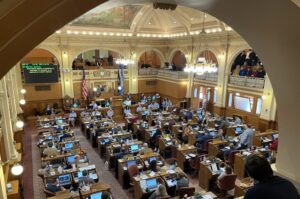
(S.D. News Watch)–Fifty percent of South Dakotans registered to vote cast ballots as of Tuesday night when the polls closed, in what may be an all-time low for general elections in the state, according to the South Dakota Secretary of State’s office.
In 2022 – the last midterm election – nearly 60 percent of registered voters showed up to the polls. Records from the Secretary of State’s office, which date back to 1964, don’t show a lower turnout percentage than this year’s election.
Here are answers to several questions about Tuesday’s historic election:
Why was voter turnout so low?
Jon Schaff, professor of government and director of the Center for Public History and Civic Engagement at Northern State University in Aberdeen, said that it’s hard to say what the reason for the historically low turnout could be. But it could be due to a lack of inspiration from Republicans to vote as they see declines in approval for President Donald Trump and U.S. Sen. John Thune, who’s currently serving as majority leader, he said.
What I was actually thinking about was, ‘What the heck happened here?’ We are in a pretty Republican state. Maybe one of the things that happened is that sort of a depressed Republican vote didn’t come out. But if that was the case, I would just expect to see at least a little bit more success with Democrats,” Schaff said.
“Even though people might not be mad at (U.S. Sen. Mike) Rounds, (Attorney General Marty) Jackley, (Gov. Larry) Rhoden etc., could they be angry just in general at the president, Republicans in general, and their way to express that is by not voting? They’re just not enthused about voting for Republicans.”
Oglala Lakota, Todd and Ziebach counties saw the lowest turnout rates – just over a quarter of registered voters went to the polls in Oglala Lakota County, and just 37 percent and 36 percent in Todd and Ziebach counties.
Those counties are home to the Pine Ridge, Rosebud and Cheyenne River reservations, extremely rural areas of the state that frequently struggle with turnout. Voting centers are few and far between and many voters don’t have reliable transportation to get to the polls.
But Pennington and Minnehaha counties, home to the state’s two major metro areas of Rapid City and Sioux Falls, also struggled with turnout, seeing less than half of their registered voters go to the polls.
chaff also said that the lack of significant ballot measures could be a contributor.
“Sometimes that’s the sort of thing that can really get people to the polls, is that they’re super motivated on ballot questions. And we didn’t really have that this time,” Schaff said.
Did SD Democrats lose everywhere?
Not entirely.
While Republicans swept races for all statewide offices, Democrats gained four seats in the state Legislature, giving them 12 total. Those pickups came from districts in the Sioux Falls metro area, including District 10, which currently has one Democratic and one Republican representative and flipped to two Democratic seats on Tuesday.
Republicans still maintain a supermajority in the Legislature. Schaff said that the pickups are something to celebrate – the Democrats gained ground in the Legislature for the first time in over a decade – but that it does not ensure that the party will see significant changes in the upcoming session.
The statewide losses came as nationwide, a “blue wave” secured majorities for Democrats in the U.S. House and U.S. Senate, flipping longtime Republican strongholds like Kansas, Texas and South Carolina.
“It seems like on the whole, the blue wave seems to have missed South Dakota, with maybe some minor exception of the (state) House of Representatives,” Schaff said. “If you’re a Democrat, I guess you can be excited that you added seats, but you’re outnumbered 5 to 1 at least in the Senate. So it’s not like, at this point, the Democrats have an effective minority that can actually gain concessions from the Republicans.”
Amendment L, which would require a 60 percent vote to amend the constitution, and Amendment I, which would have repealed expanded Medicaid coverage if federal funding goes away, were largely opposed by Democrats and failed to pass, marking a win for the party.
Was South Dakota the only state to maintain a Republican stronghold?
While races across the country heavily favored Democrats, several races still went to Republicans in reliably red states across the country.
In particular, South Dakota neighbors Wyoming, Nebraska, Montana and North Dakota remained firmly Republican, electing members of the party to federal and statewide seats. Together the bloc remained a Republican stronghold region amidst other areas that flipped seats to Democrats, like the Southeast, Texas and Alaska.
Montana and Nebraska both elected a single Democrat to the U.S. House while remaining Republican in other elections.
Will the next election be different with the passage of Amendment J?
Nothing will significantly change for voters in South Dakota.
Amendment J formally enshrines in the constitution the requirement that only U.S. citizens can vote in South Dakota elections. That was already procedure in the state – noncitizens are not allowed to vote in South Dakota – but proponents of the amendment said it would help secure elections for voters.
Is Amendment L done for good?
Not necessarily.
Though the effort to raise the threshold to amend the constitution has now failed for a third time after similar previous votes in 2018 and 2022, it is still possible for the state Legislature or for citizens to initiate another referendum via petition.
However, with the now-confirmed unpopularity of the amendment, it is unclear whether proponents of the supermajority measure will push another attempt to pass it.
How did local elections go?
Rapid City School District residents voted overwhelmingly in favor of a $107 million bond with 67 percent approval, easily surpassing the 60 percent supermajority needed to pass. It will fund school building and security upgrades, school renovations and two new elementary schools.
Rapid City has not passed a school bond in over half a century, and voters most recently declined to approve one in 2020. That 2020 measure sought $189 million for the construction of three new elementary schools and a middle school, among other projects.
In Brown (Aberdeen) and Codington (Watertown) counties, voters denied measures that would increase sales taxes to decrease property taxes.
Those proposed tax changes came from SB96, which allows counties to elect to raise their sales tax rate by half a percent, with the proceeds going to lowering property tax rates. Gov. Rhoden, who introduced and signed the bill, called the legislation part of “the largest property tax cut in South Dakota history.”
In Codington County, the measure came from a resident-submitted petition after the county commission passed the tax change. Brown County specified that its tax increase must be approved by voters, not the county commission, which pushed it automatically to a November vote.
In Codington County, the measure was defeated with 60 percent opposed and 40 percent in favor. In Brown County, it was a 56 percent no vote to a 44 percent yes vote.